
VS #132 Winter 2026

COMIX LEGEND: NEAL ADAMS!
As Told To Pat Jankiewicz
Neal Adams was a comic book artist who revolutionized the industry with his unique drawing style and an impressive run that saw him illustrate almost every single character for Marvel and DC. “If superheroes were real, they would look the way I draw them,” he joked. His death at age 80 on April 28th, 2022 marked the end of an era. Neal Adams, Madison Avenue ad man-turned-comics legend, changed the industry. Adams’s action-packed art would have a photo realistic Batman leaping in your face, and his lifelike characters struck realistic poses. He restored Batman to his dark creature of the night roots, co-created important members of his supporting cast (including arch villain Ras Al Ghul, femme fatale daughter Talia, and Man-Bat), and created one of the first comics to generate worldwide press attention, the massive tome, Superman vs. Muhammad Ali. The book pitted the fictional alien in a life or death battle against the real, legendary boxer. Adams’s art influenced generations of artists, including John Byrne, Frank Miller, Bill Sienkiewicz and George Perez, as well as his son Joel Adams, who designed characters for the long-running TV series, King of The Hill and The Incredible Hulk cartoon, and youngest son Josh Adams, who draws for DC Comics and won a Pulitzer Prize. Behind the scenes, Neal Adams was more than just a creative force. He waged a PR campaign to pressure DC Comics into financially helping maligned Superman co-creators Jerry Siegel and Joe Shuster, who had fallen on hard times. Adams convinced the company to take care of the two men, giving them pensions and credit for creating The Man of Steel. “It was the right thing to do,” said Adams. With his warm grin, perfectly coiffed hair and crisp blue shirt with rolled-up sleeves, Neal Adams looked more like a city councilman than a comic book creator when he welcomed me into his art studio/comics shop, Crusty Bunkers, in Burbank, California.
PAT JANKIEWICZ How did Superman vs. Muhammad Ali come about?
NEAL ADAMS The book came my way because Ali’s people liked how I drew his likeness [after the project originated with artist Joe Kubert.] It was a 72-page book and I’m really proud of it.
PJ If Superman fought Muhammad Ali, one assumes you would need to find something else for Superman to do by page two!
NA That’s why we had to find a way to make it a fair fight, so Superman boxes Ali under a Red Sun, which takes his powers away. You put him up against Muhammad Ali, you see they’re two equal human beings, even though Superman is Superman and also an alien. A lot of fellow artists and fans look at my Superman in that Muhammad Ali book as a perfect example of what Superman is all about. That really pleases me.
PJ I like that Superman is boxing in his full cape and costume.
NA Yeah, Superman has to wear his costume in the boxing ring because the alien spectators “wouldn’t be able to tell the fighters apart!” It’s explained that, ‘Except for subtle changes in hue, all humans look exactly alike to them,” so we got a little social commentary in there.
PJ Did you meet Muhammad Ali?
NA Sure did. I met him at a news conference and he was very Ali. The comic book was covered all over the world, in TV, newspapers and magazines. That was crazy!
PJ Is it true that Superman vs. Muhammad Ali took so long to draw, Muhammad Ali lost the title to Leon Spinks before it was released?
NA Yeah, I caught a lot of sht over that, but Ali reclaimed the title later that year! The Superman vs. Muhammad Ali book was sort of my magnum opus and all of my feelings about Superman. You go through that book, you’ll see sides to Superman you have seen before and sides that you haven’t. You see a lot of his humanity and a lot of his super powers—particularly when you see him as this little character in space, up against these massive spaceships. You see him weakened, you see him beaten up—it was either the first time or one of the first times where Superman loses his super powers and just gets the sht kicked out of him…And he looks it! You really don’t expect to see Superman with a black eye, looking terrible.
PJ Yeah, that was disturbing as a kid.
NA I sort of reintroduced Superman in that story. I have him get his powers back and fly through an armada of space ships, which I thought was really cool. It’s a great visual! Oddly enough, I didn’t do a lot of Superman stories, just covers. DC Comics thought Superman vs. Muhammad Ali didn’t sell well when it first came out, but I later found out that collectors were actually buying boxes out of the back of their warehouses when it was first released. They were carrying [out] copies that were not sold or destroyed; now 40 years later, pristine copies are suddenly showing up! It’s become a classic book, which I am very proud of.
PJ That cover, of Superman and Ali in the ring, with all the celebrities in the audience is legendary!
NA In that Superman/Muhammad Ali cover, I made sure that [Superman creator] Jerry Siegel and Joe Shuster were there in the audience. Christopher Reeve is there. I also put my kids in as spectators, among the president, Batman, Lex Luthor, and all the real-life celebrities. The cover of Superman facing Muhammad Ali was so iconic, they asked me to do an homage to it for the millennium edition of ESPN Magazine, with Michael Jordan facing Muhammad Ali in a similar pose!
PJ Was it fun to revisit one of your most famous covers?
NA Oh, yeah! These are the 100 greatest athletes of the century. This cover won’t be done again for 100 years, so I wanted to get it right. It’s ESPN’s list—a lot of athletes disagreed, but the art director chose me. Only five percent of comic book fans are women, so this art director, who was a woman, must have been one of the five percent because she remembered my Superman vs. Muhammad Ali cover! She said, “I want you to do that cover, except instead of all of the people you originally put on that cover, I want you to put in the 100 greatest athletes of the century in the audience —if you can!” I said to her, “Why do you want to do that?” She said, “If you don’t do it, we’ll just run 100 different photographs and I think this would be more interesting!” I agreed with her and said, “Cool, absolutely!” I had a lot of fun with it. The audience includes [racehorse] Seabiscuit, Magic Johnson and Billie Jean King. I was very politically conscious when I recreated the cover; I put OJ Simpson below the crease but I wanted to put him on the crease!
PJ You used your daughters in several stories, right?
NA Yes. Kris, my oldest daughter, appears in a DC Comics horror story I drew, called “Nightmare.” It’s about a very sick little girl lured by Pan into this fantasy world. That was all my daughter Kris. At the end of the story, we see Pan is actually a yard sculpture in the yard’s garden. She has that story up on her wall! I didn’t have to make her pose; I knew what my kid looked like! My kids are all locked in my head, I can draw any one of them at any time! I have used my sons Joel, Jason and Josh in different stories and covers.
PJ You had your other daughter meet Superman in the Clark Kent story, “The Baby Who Walked Through Walls” (Superman #251).
NA I did—Len [Wein] wrote that. It was a cute story about Clark Kent and a baby girl he has to babysit. My daughter Zeea was the most adorable baby, so I cast her in the story. I was drawing this story where Clark Kent had to babysit a neighbor’s baby. I liked this short back-up story because how do you turn Clark Kent into a human being, even though he’s Superman? Well, I was surprised when this little Clark Kent backup story was read by everybody and reprinted a lot! There are no super heroics in it at all. It just required an artist who understood human beings, in a Norman Rockwell kind of way, to carry off a story like that. I think Zeea has that Clark Kent story. She does computer work for my books now!
PJ You did all these great Superman and Batman covers that would make people buy the book, only to find you didn’t do the interiors!
NA I had a tradition of doing that at DC Comics, where I did all these covers of books that I didn’t draw, so kids would buy Superman’s Pal, Jimmy Olsen, Jerry Lewis, or Superman’s Girlfriend, Lois Lane because of my covers! That was my job, to get you to buy it!
PJ There’s an online site collecting all of your covers of Superman being mean to Lois Lane and Jimmy Olsen called Supermanisadick.com
NA I wasn’t trying to make Superman look like a jerk. I was just trying to do my job and sell comics by coming up with interesting covers! Normally, I would read the comic I was going to draw the cover for but I often found there was never a good picture inside it, so I would have to make something up. I would do an idealized picture loosely based on the story. One of my favorite covers was one where I had Superman sitting in the witness chair in a courtroom and there was a little girl pointing at him saying, “He killed my Daddy!” (Action Comics #359) When does that ever happen? She’s pointing to the witness stand at Superman who is sitting there like a goof! Totally unrealistic, but it sold a lot of comic books which was my job. I didn’t just make it up. If people are throwing rocks at Superboy in the story or Superman was telling the reader he was murdered, it had to come from something in the comic! I think I’m a pretty good cover artist. I can go to the key idea in the story and turn that into a cover because I have had a lot of experience doing advertising. I take the best picture from the story, turn it into a cover and draw it really well, but it doesn’t really tell the story. The idea in those days was, since you were selling comics at a newsstand, you wanted a cover that would intrigue people into buying the magazine! In comic shops today, you have your books and flip through them to decide if you want it. Nowadays, the cover rarely affects whether you get the book or not, but in those days, itdid. Oddly enough, outside of a“World’s Finest” story I didn’t do many Superman stories. I did a lot of Superman covers and the Superman vs.. Muhammad Ali book.
PJ Your horror comic covers are pretty nightmarish!
NA When I was doing covers for Witching Hour and other DC horror books, the gimmick that I came up with was, remember when you were a kid, stuff always scared you? So, let’s do a series of covers of kids scared by stuff! If you look at all my covers, it’s always kids caught in terribly spooky situations. I experimented with creating dimension in colors. I would fool the reader by using color to create dimension—the color makes it look like there’s dimension to it. Some people would buy the book just to cut off and collect the covers.
PJ When I was nine, my favorite T-shirt was of your Batman—
NA Was Batman running?
PJ Yes, with his hand jutting forward!
NA They—DC— would lift a lot of my Superman and Batman images off my covers and interior comics and use them for licensing, for T-shirts and posters. That picture was a full page panel of Batman running, which was from one of my comics [Batman #251, “The Joker’s Five Way Revenge”]. It got reprinted everywhere—including your T-shirt! I mentioned that to DC Comics. I said, “Guys, when you use those drawings like that, don’t you feel I would like to be paid for any of that?” They assured me that I should be flattered they used it! Somehow, I couldn’t pay the rent with their flattery. I said I wasn’t grateful because I would really rather be paid! So, subsequent to that, when I got to be a pain in the ass to them by calling it out, they got [comic artist] Jose Garcia-Lopez to imitate my stuff and do all the licensing and pay him! So, at least somebody is getting paid!
PJ You’ve also made an impressive side career doing movie posters.
NA Yes, I did Michael Crichton’s Westworld, I did Phantom of the Paradise with Richard Corben, and I designed the Re-Animator poster from a photograph of Jeffrey Combs. The director, Stuart Gordon, was a friend and I designed the costumes for his play, Warp! With Re-Animator, I told him, “Stuart, you’re gonna need a good poster to sell this thing!” I usually did posters for cheap movies. I did the poster for a Jackie Chan movie, Snake and Eagle Shadow, when they re-released it. I did B-movie posters, usually for cheap horror films, cheap vampire blood and guts films. I even did the Grizzly poster. The worst damn bear movie ever made!
PJ In the comics, you took Batman back to his noirish ‘creature of the night’ roots after the Adam West ‘60s.
NA Yes, I started changing Batman when I was doing [the Batman team-up comic] Brave and the Bold. My editor, Murray Boltinoff, was the kind of editor who, if he thought you were doing a good job, he left you alone. If there was a scene with Batman running around during the day, I just changed it to night when Batman would look more impressive. Julie Schwartz, who was editing the main Batman titles, started getting letters from readers asking him, “Why wasn’t Batman like he was in The Brave and the Bold?”
PJ You also created Man-Bat, right?
NA Yeah. Man-Bat came because it just occurred to me that Batman had sort of run out of good villains. I was just writing out names one day and I thought, ‘Man-Bat?’ That would be a pretty good idea! A scientist fan of Batman wants to help Batman become even more powerful. He invents a serum that would turn Batman into more of a bat, thinking Batman would like this idea. A little loopy thinking on his part. I then thought if Marvel decided to do a Man-Bat character, they would really screw the hell out of DC! I was gonna present it to Julie Schwartz, so I walked into his office one day, where he was working with writer/artist Frank Robbins. They had come to a dead end, plot-wise. So Julie did something he rarely did, he turned to me and asked, “Got any Batman plots?” I said, “Y’know, Julie, I actually do: Man-Bat. I will tell you the Man-Bat story and I will tell ya, Julie, sooner or later, somebody at Marvel is gonna sit back and say, ‘Why don’t we do a Man-Bat? Everybody at DC is gonna be really embarrassed.’” He said, “Okay, tell me Man-Bat’s story!” I do and Julie says, “Do you have to write it? Or can Frank write it?” Frank Robbins was sitting right there and needed a plot. I said, “Tell you what, Julie, I have a plot in the other room and I would be glad to give it to Frank.” Julie says, “If I agree to this, will you draw it?” I said, “You’re trying to bribe me? I just gave you one of the best Batman stories DC has ever had! But yes, I would be glad to draw it.” Man-Bat comes back every year in Batman comics. He’s a good character, even got his own action figure, which I don’t have—they never sent it to me!
PJ I notice in a lot of your stories, Batman usually fights nature. He battles sharks, leopards and falcons, usually killing them!
NA I don’t think Batman has any sense of animal life being worth anything! I didn’t write those stories, Denny O’Neill did. I just illustrated them. As an artist, once I accepted the script, I would follow it because that is what the job is. If you accept the script, that’s the job. I don’t believe in changing peoples’ scripts.
VS #126
KING OF THE C.H.U.D.! DOUGLAS CHEEK
As told to Pat Jankiewicz
In one of his last interviews, Cannibalistic Humanoid Underground Dwellers director Douglas Cheek, who died in 2021, chatted with Pat Jankiewicz on battling producers and influencing Aliens with his sewer monster success story. When random citizens begin disappearing around Manhattan, a grieving cop (whose wife was eaten by a C.H.U.D.) and a soup kitchen clerk uncover a conspiracy–carelessly stored toxic waste is turning sewer-dwelling homeless people into monsters who surface to eat fellow New Yorkers! The goofy, lovable movie came and went in theaters before becoming a cable TV staple. It’s been referenced by The Simpsons, Saturday Night Live, Rick and Morty, Aqua TeenHunger Force and Archer, making C.H.U.D. the most famous New York monster since King Kong. In Santa Monica, past high white walls: a Japanese pagoda that looks like something out of 17th century Japan. This was the sanctum sanctorum of producer/director Douglas Cheek. Inside, framed posters for acclaimed documentaries he edited. “This is the original ad,” he grinned, showing off the poster with a monster hand opening a manhole cover. “This is the ad that sold the movie!”
“What’s amazing is you have serious actors taking cannibal monsters seriously.”
“I actually kicked off my clothes and demonstrated the angle. That was a mistake because she was horrified!”
PAT JANKIEWICZ How did you get involved with C.H.U.D.?
DOUGLAS CHEEK A good friend, Shep Abbott, who was the original writer [and receives story credit], before [screenwriter] Parnell Hall came on. This was all his bright idea, C.H.U.D., and it just cracked me up. I helped Parnell out on his first pass of the script. I had no idea that I would eventually direct it. It was just so crazy and smart. The producer who bought the rights, Andrew Bonime, he and I—we never hit it off. But when I met him, certain things I said about the project made him look at me and say, “Okay, you’re the director!”
PJ Had you directed before?
DC Yes, for a ‘70s TV show called Vegetable Soup. I was born in Maryland and filmmaking came to me by accident. I started out wanting to be an actor, and then this picture, C.H.U.D., came about completely by accident.
PJ Most of your cast became big stars with your two leads, Daniel Stern and John Heard, starring in Home Alone, the highest-grossing comedy of all time.
DC The main guys are my closest friends, Danny [Stern], Chris [Curry] and John [Heard], who plays George, the photographer who first notices homeless disappearing. They would do anything for me, so this was their chance to prove that!
PJ Were they reluctant to do a monster movie?
DC No, not at all! They had fun with it and really got into it and became very possessive of it.
They’ve never had that kind of power on their bigger movies and they were doing this for scale. They made their characters quirkier and more interesting. They were all broke actors who knew each other—they’re all kinda proud of it, they will still talk about it to this day and share C.H.U.D. stories. It was a cast of people who were only actors, collecting a paycheck and doing the work, when suddenly they were part of the creative team.
PJ I love the opening scene–the C.H.U.D. eats the woman walking her dog immediately–and her poor dog, too! You get right to it, even before you show the title.
DC You’ve got to–you have to grab the audience’s attention right away. That’s Danny Stern’s wife, Laure Mattos, who plays the first victim. We made her the cop’s wife. That gets the cop, Bosch [Christopher Curry] into it.
PJ What’samazing is you have serious actors taking cannibal monsters seriously. John Heard of Cutter’s Way and Daniel (Diner) Stern give legit great performances.
DC Danny and John, especially, got all these ideas for their characters. They were great ideas that made the film and their motivations stronger. I would usually like their ideas and then have to go through the producer who thought his version is the one that should be done. There were no big blow-ups on the film, thankfully. I was never able to get the producer to feel he was part of ‘the inner circle’ with the rest of us but I did try. That’s because the actors and I went back for years, we had a long history together. [The producer] kind of dogged on his film for years because he felt bad about C.H.U.D. and tried to mess with it. It was a tough situation.
PJ What was the shoot like?
DC It wasn’t a long shoot–I think it was about six weeks. Our budget was under $300,000. Everybody who was on that picture treated me warmly because it was a whole bunch of friends.
The only problem was every single one of them just couldn’t stand being around Bonime. They had to ‘fake it’ with the producer. I, of course, had to continue a good enough working relationship with Andrew to make the film, but he had wanted to direct it himself originally, so that always causes friction. Somehow, in my interview, I had talked him into letting me direct it.
Also, the producer didn’t like Shep, our friend. He wanted to get rid of him, so he bought him out so that he owned the script and then brought in another writer, Parnell Hall, to do it.
PJ The funniest conceit of your film: the evil government bad guys feel ‘Cannibalistic Humanoid Underground Dwellers’ is the cover story they’re comfortable with the public knowing to hide that C.H.U.D. really means ‘Contamination Hazard Urban Disposal’!
DC Danny and Chris came up with that.
PJ: Were the monsters the way you envisioned them?
DC Well, I didn’t see them being the way they turned out! In fact, the only way to get the producer off my back was to let him design the C.H.U.D. What I had always wanted them to be was very human-like creatures, not the rubber monsters with glowing eyes in the movie! I wanted them to be quick, able to run, and be much more human. I thought all we really needed to do was change their eyes, just get their eyes to glow.
PJ Their eyes do glow! In your producer’s defense, that monster on the poster looks pretty damn cool.
DC I had to give the monster design over to him. Because I gave him that, he stayed away from me while I was filming. It was a trade-off.
PJ At the climax, a C.H.U.D has our heroine cornered, he suddenly stops chasing her, so his neck can stretch three feet! Why did it do that?
DC That was the producer’s idea. It’s so weird–the C.H.U.D’s neck suddenly has a hard-on! I was appalled–I wanted them to be human; instead, I have a rubber monster with big light bulb eyes.
PJ: Is it true an FX guy did the roar of the C.H.U.D. by growling into a cardboard paper towel roll?
DC Yes! He was a talented makeup FX guy, Kevin Haney, a really good guy! The first film I ever made, Shoe Shine was also set underground. I shot it silent and made all the sound FX later. I created the atmosphere and sounds by blowing in tubes. Sound is always important in a film and the perfect sound fits the film. So if a FX guy making scary sounds in a paper towel roll works? That’s our C.H.U.D.
PJ You have an amazing set piece, arguably the film’s best scene, where cops go into the sewer to fight the monsters. How did you feel when James Cameron re-staged that exact scene two years later with his space marines for Aliens?
DC THAT’S RIGHT, THAT’S RIGHT!! It never occurred to me, but that’s the exact same scene! The Aliens attack the space marines just like the C.H.U.D., right down to the cops using flamethrowers and the cameras on the individual cops blanking out. He uses the sound of the tracking signal when the Aliens close in instead of a Geiger counter. He had more money to do it on Aliens than I had. If he can re-purpose a scene from C.H.U.D.? Go for it! Aliens is a classic.
PJ The sewer attack is one of the coolest things in the movie.
DC I really like how we paid off the sewer attack sequence later in the film. When Danny Stern is trapped where the C.H.U.D. killed the guys earlier, he pulls the headset off a severed head to call for help! Danny may have come up with that bit.
PJ Was it hard to pull off a big scene like that, with stunts, gore, flamethrowers and monsters?
DC I edited a lot of stuff, so as an editor-turned-director, I knew exactly what I wanted and needed to get that scene. That was a very big sequence and we put up with a lot of low-budget stuff to get it done. As an editor, I knew how to get the most out of every shot and exactly what I needed to show. This was something different and unique, so I just surrounded myself with people who trusted me and I trusted them. Nobody had any ‘names’ or reputations yet, which made it very simple on my side of things.
PJ A lot of stuff was shooting in New York at that time, right?
DC Oh yes, while we were doing our little monster movie, Ghostbusters was also shooting in New York. We ran into the Ghostbusters crew constantly. They were able to block a lot more streets than we ever could!
PJ New World Pictures’ original theatrical cut of C.H.U.D. actually had a Ghostbusters joke!
DC Yeah, when our heroine is trapped, screaming for help, they dubbed in a guy yelling, “Call the Ghostbusters, lady!” That’s out now, it didn’t belong. It’s supposed to be a scary scene!
PJ Some claim the movie was shot in both New York and Jersey?
DC I don’t think any of it was shot in New Jersey. Oh, Reverend’s Soup Kitchen was in Jersey City! As for the rest of the film, it was basically a downtown movie, shot on downtown streets and restaurants, as well as Central Park and the Chambers Street Subway station. We were shooting under the Brooklyn Bridge and inside the bridge.
PJ It looked amazing!
DC That’s because it was amazing! One of the greatest places, that looks really good in the film, was a storm sewer that actually opened up to natural light–that was a great place to shoot. It looked like a million-dollar set!
PJ Were you worried about asbestos, mesothelioma and other bad stuff?
DC Never even thought about it! Inside the bridge was really interesting.
PJ What did you like most about C.H.U.D.?
DC To get into the really funky locations. It was amazing that I had this great cooperation from the city. They actually let us get into areas you don’t usually see in movies. We were working in dark, wet places full of rats but we got great footage out of it. We had an extremely good art team on the film who re-created those locations. Sets we could put water on. It looks pretty seamless in the film. The art department-built storm sewer matched the real one in the film perfectly. Because of our under $300,000 budget, we stretched every dollar. Happily, sewers aren’t expensive! They’re pretty cheap, actually. We shot our actress battling the monsters in a failing loft that the owners of the loft didn’t seem to care that we were destroying their floor! Everything had to be wet or it wouldn’t work.
PJ Your leading lady, Kim Greist, did C.H.U.D. right before Terry Gilliam and Michael Mann worked with her on Brazil and Manhunter.
DC That’s right–Kim was brand new. She came in with no resume to speak of, and I just liked her. I didn’t say that right away, we had a nice conversation, and she gave a nice audition. I said, “Thanks for coming, we’ll be in touch.” She walked down the stairs and into the street. With just a few words in her audition, I thought, “She’s got to be the one!” I ended up running down the block, catching up to Kim and tapping her on the shoulder to tell her, “You got the part!”
PJ She bailed on the nudity in her shower scene, a mandatory shot for all ‘80s horror film heroines.
DC Yeah, she did. She wouldn’t do it, but I must say I did my best to talk her into it! I shot the hell out of the shower scene! I said, “Kim, you are just turning 180 degrees, that’s all we’re doing, we’re not exploiting bodies here.” I actually kicked off my clothes and demonstrated the angle. That was a mistake because she was horrified! It was the last thing I should have done!
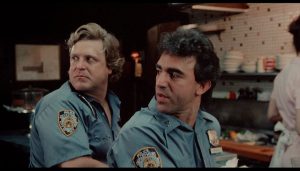
PJ You had pre-fame John Goodman and Jay Thomas as the two cops eaten in the diner.
DC I had not worked with either of them before. Jay Thomas was brand new. John I sort of knew among the circles of friends at bars and stuff. I didn’t know him well but a nice guy.
PJ You have a ton of now famous people in C.H.U.D.
DC A lot of people in the movie went on to bigger and better things, John, Jay, Kim, Eddie Jones (Lois & Clark), Jon Polito (The Crow, The Big Lebowski, Barton Fink), Frankie Faison (Silence of The Lambs), Michael O’Hare (Babylon 5), and more.
PJ When the cops go into the diner, you’re not expecting the C.H.U.D.
DC That’s why it works–John Goodman is good as the cop. He has that funny scene where he flirts with Hallie Foote (playwright Horton Foote’s daughter) before they’re both eaten! Hallie showed up to audition. She was great and I said, “Yeah, let’s hire her for the waitress!”
PJ You have two bums watch them all get eaten. Why doesn’t the C.H.U.D. attack the bums?
DC There was a very practical reason for that. Because I was one of the bums! I’m the bum who yawns, falls asleep during the attack, while the other bum runs away!
PJ When C.H.U.D. opened on August 31st, 1984, what was your reaction? Happy with it, relieved it was finished?
DC I was pleased it was out there. Did it make money? Not for me! Some people made money. When C.H.U.D. hit cable, it ran and ran and ran. That’s how its popularity grew and spread. I wasn’t even paying attention while it happened. Suddenly, everybody knew C.H.U.D.
PJ C.H.U.D. ran so often, Saturday Night Live did a Cable Ace Awards parody where C.H.U.D. won ‘Best Movie on Cable’ three years in a row.
DC That really cracked me up! They had Kevin Nealon playing the producer of C.H.U.D. as he wins again, saying something crazy, “The Third Time is the sweetest,” and acknowledging how often it ran.
PJ Did you see it referenced on The Simpsons?
DC Oh yes, I loved that! Marge tells Homer, “Of course, you’ll have a bad impression of New York if all you focus on are the pimps and the C.H.U.D.s!” I loved when The Criterion Collection pulled an April Fool’s Day joke, where they announced their next release would be C.H.U.D. I had no idea that C.H.U.D. was going to have that kind of a life and continue to be so well known…It’s kind of thrilling! To see how it’s moved on into pop culture is both thrilling and unexpected to me.
PJ People love it to joke about it so much.
DC Happily, we, the makers, are in on the joke–we knew C.H.U.D. was crazy when we were making it…And there was nothing they could do to stop us! What’s amazing to me are the people who get a thrill when they find out I’m the director of C.H.U.D. It’s like, “Oh, I love C.H.U.D.!” It always surprises me when they discover that I did it–this is just a little movie, but they get so excited about it.
PJ You didn’t keep directing after it came out, you focused on editing.
DC After C.H.U.D. came out, I had a ‘name.’ I was able to get meetings and realized that I would have to go out and sell myself to people to make more movies. I realized what I would have to do to sell myself. You had to self-promote. That’s just not me. As an editor, I always felt my work is there to see. To come on strong with ‘hire me, I’m the guy’ for a director job didn’t sit right with me. I don’t regret it at all. I just didn’t like what needed to be done to get the next job, so I never tried that hard to get it. As you can see, being an editor worked out very well for me.”
KEVIN HANEY: SOUND OF THE C.H.U.D.
“I was hired as FX crew, helping with sculptures, molding and engineering the SkinFlex final monster effect. As a kid, I liked making monster sounds. I found using a deli cup slider adds another dimension as does a metal pipe. I was very amused that my vocalizations ended up as the C.H.U.D., although they are very processed.”